
Vimalgo
Vimalgo is the AI-driven headhunting and recruitment management system ELO built for Cannella & Partner Solutions AG, a Swiss staffing firm in Möhlin. It automates the part of recruitment that used to be pure manual reading — parsing CVs into structured candidate profiles, keeping a job database current from external portals, and surfacing high-potential candidate–job matches — then tracks each application end to end from first contact to placement. Fauzul was the main driver of the AI demo that opened the engagement: showing a working AI matching flow early enough that the client chose to bet on the AI promise rather than wait for it, a bet the platform has since delivered on.
The bet
A three-person recruitment firm competes on how quickly it can put the right person in front of a client. Every hour a consultant spends reading CVs, retyping details into a profile, and re-scanning job portals is an hour not spent on the placement itself — and in 2024 the credible version of "AI will fix this" was still mostly a promise.
Fauzul led the demo that made the promise concrete: an AI-driven matching flow the client could try against their own material rather than a slide deck about what it would eventually do. That demo is why the client committed early instead of waiting for the category to mature, and the platform launched in January 2025.
What the platform does
- AI-powered CV parsing. Résumés become structured candidate profiles — personal summary, skills, experience, certificates, degrees, fields of study — without retyping.
- Job–candidate matching. Automated matching surfaces high-potential pairs between the candidate pool and the live job database with minimal manual work.
- Self-updating job database. Job records auto-update with new posts pulled from different job portals, so the pool being matched against stays current.
- Advanced search and filtering. Narrow a candidate pool down to a shortlist for any specific job across skills, study fields, degrees, certifications, and tags.
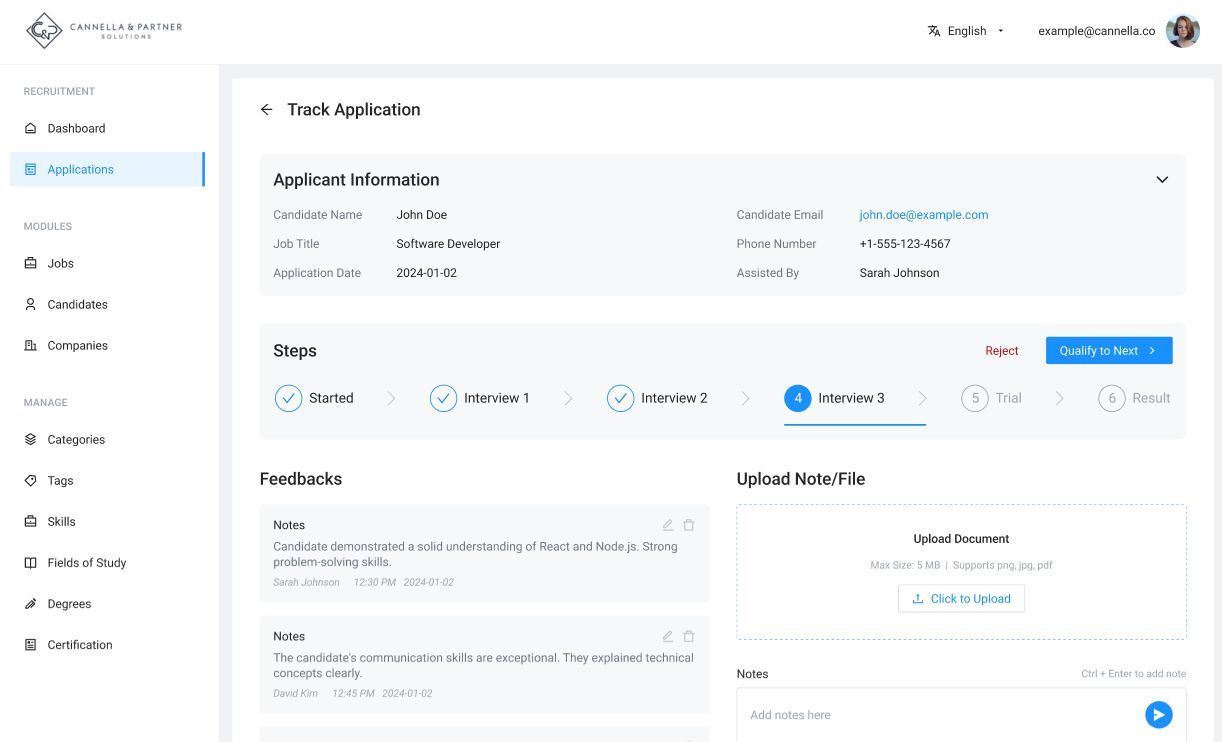
- End-to-end application tracking. Every application moves through an explicit pipeline — started, interview rounds, trial, result — with per-stage feedback notes and document uploads attached to the record.
Why it holds up
The AI is the wedge, not the whole product. Parsing and matching only pay off if the surrounding system is honest about state — who was interviewed, by whom, what they said, what happens next — so the platform was built around an explicit application pipeline with feedback and documents attached at each stage, rather than an inbox and a spreadsheet with a model bolted on.
That is also what made the early bet safe: the recruitment workflow keeps working on its own terms, and every improvement to the matching quality lands on top of it.
High-calibre architecture decisions.
Technical Highlights
- AI CV parsing into structured candidate profiles (skills, experience, certificates, degrees, fields of study).
- Automated job ↔ candidate matching over a continuously updated job database.
- Job-portal ingestion keeping the job database current without manual entry.
- Explicit application pipeline — started → interview rounds → trial → result — with per-stage feedback and file attachments.
- Multi-language UI for a Swiss client operating across languages.
Key Decisions & Rationale
The client's decision was whether to trust AI matching at all. A working demo against their own material answered that question in a way a specification could not, and set the scope of everything built afterwards.
Matching quality is bounded by what the system knows. Parsing CVs into explicit skills, experience, certificates, and study fields gives the matcher — and the consultant reviewing it — something inspectable to reason over.
Recruitment fails on lost context, not on shortlisting. Modelling stages, feedback, and documents on the application record keeps the human process auditable while the AI handles the volume work.
By the numbers.
Vimalgo — Recruitment Workspace
The application tracking surface: applicant record, explicit interview pipeline with reject / qualify decisions, per-stage feedback notes, and document upload — with the recruitment, module, and taxonomy navigation the consultants work from.
Track Application — applicant information, staged pipeline (started → interviews → trial → result), consultant feedback notes and document upload.
If we worked together.
I bring high-leverage product engineering and absolute operational discipline: shipping weekly, pressure-testing user inputs, and automating delivery pipelines.
See it in the wild.
This case study covers how Vimalgo was built — these links open what ships today: the live product, repo, demos, and supporting material.
TheBestBroker
TheBestBroker helps investors pick a broker instead of guessing at one. I led the project through 2023 and 2024: broker listings and comparisons with an affiliate system attached, and on top of it an AI chat advisor that works off a dynamic form — the user describes what kind of investor they are and what they want to trade, and the recommendation follows from that rather than from a generic ranking. The interesting constraint was the platform: the client required the site to stay in Webflow so their own team could keep editing it, so everything intelligent had to be built on top of Webflow rather than instead of it.