
Global Jute Trading
Editorial export site for Global Jute Trading Ltd — a Dhaka-based sourcing & exporting house with 26 years as a company and 35 years of jute trading under its principals. Built to support their push into deeper international markets, with a particular focus on Canada.
The Context
Bangladesh jute is one of the most specification-sensitive commodities in global trade — GSM ladders, hessian vs sacking vs felt, treatment, certification, packaging, lamination. A serious importer in Canada or Switzerland can't evaluate a supplier from a brochure of stock photos and a phone number.
Global Jute Trading needed an editorial-grade catalogue that read like a specification sheet, not marketing — one a procurement lead could send up the chain at a mill, cooperative, or geotextile contractor.
What I built
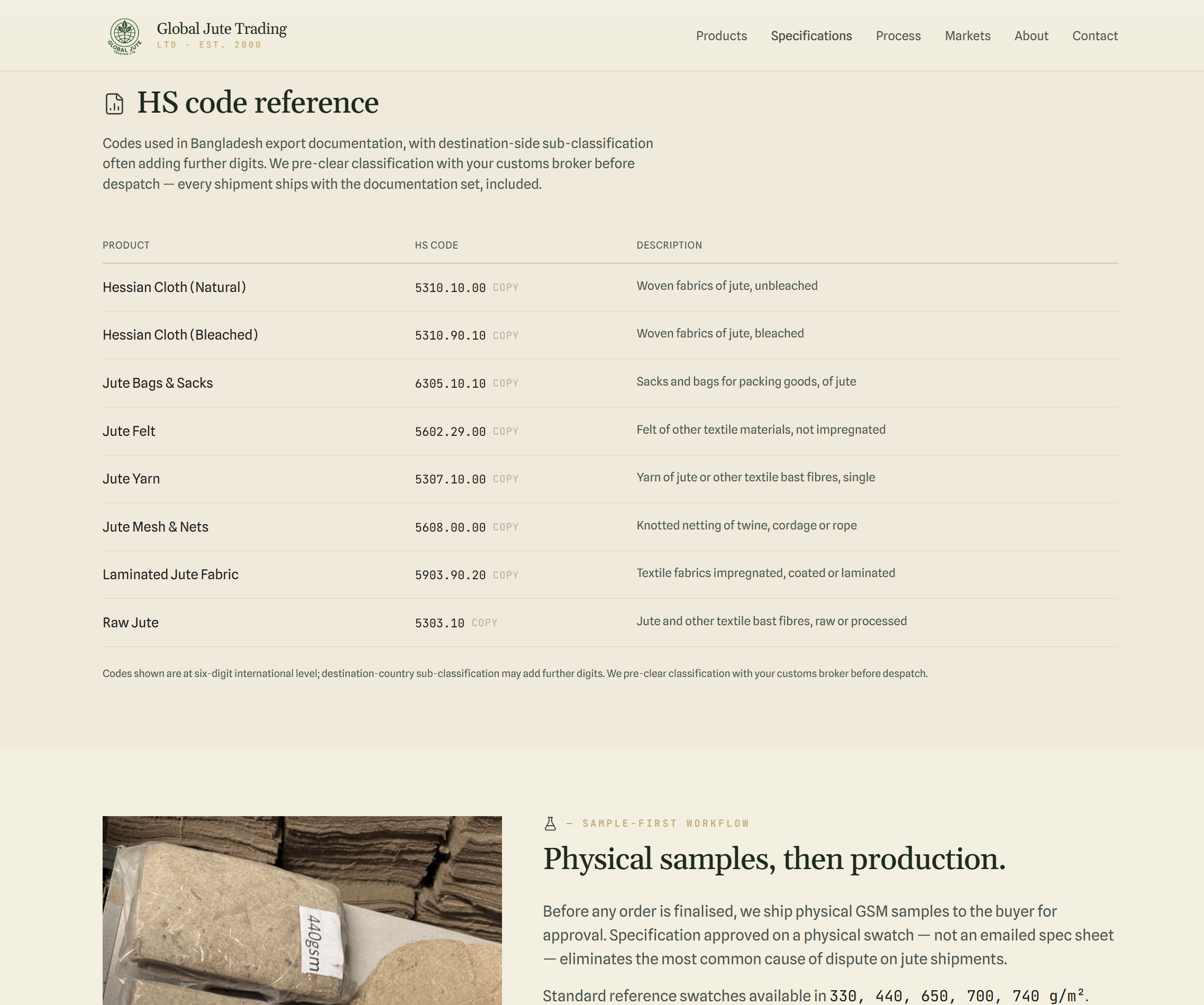
- Specification-first product catalogue. MDX-authored product pages with full GSM ladders, certifications, mill provenance, and per-category process notes — every claim sourceable.
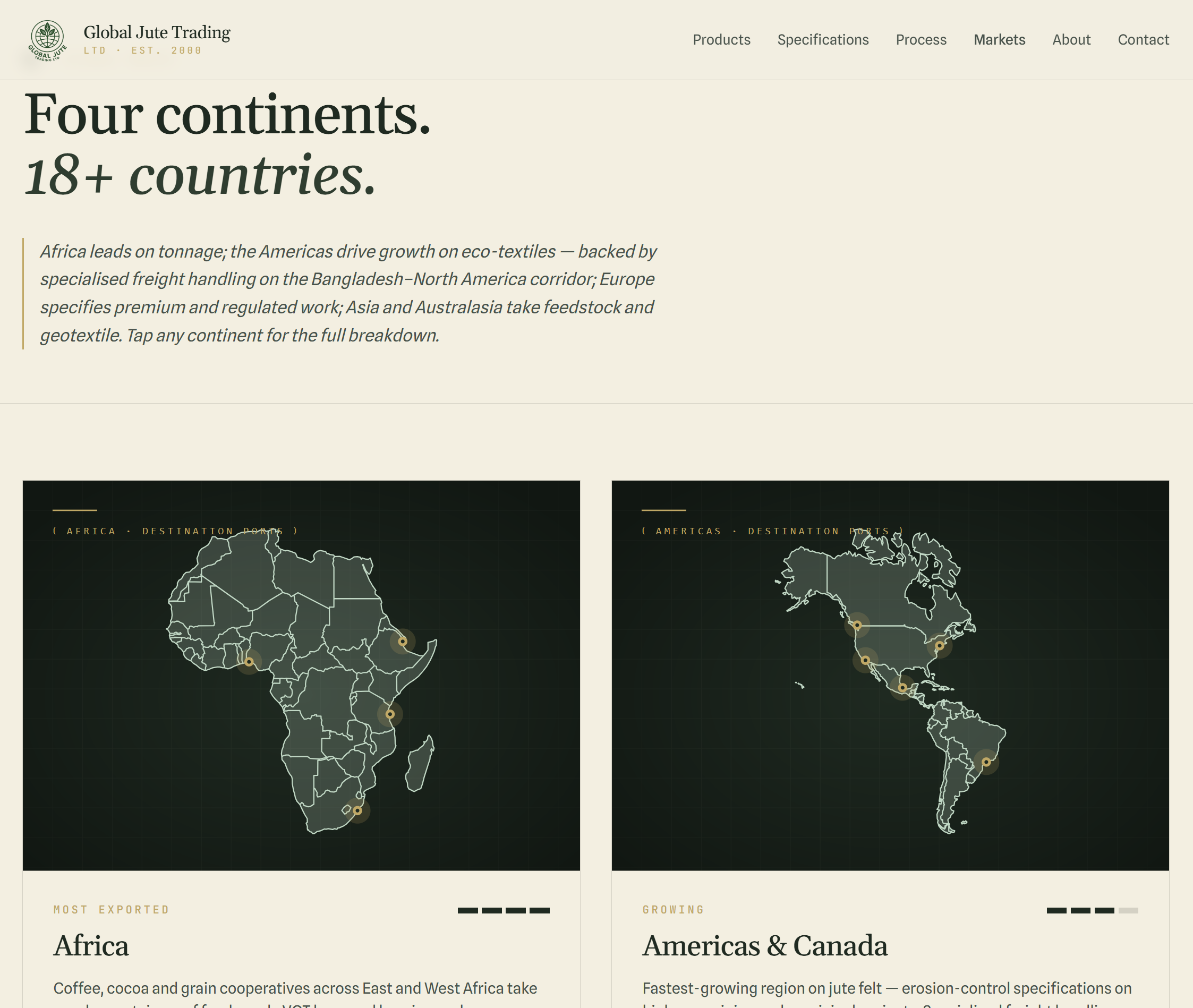
- Markets directory. A per-country / per-vertical map of where the company ships and to whom — Africa, the Americas (with Canada front-and-centre), Europe, Asia — built from a topojson world atlas and editable content data.
- Process page. The full sample-first workflow: bale sample → swatch approval → grade certificate → phytosanitary → container booking. Buyers can read the answer before asking.
- AVIF + WebP responsive image pipeline. Sharp transcodes 200+ source photos into 480/768/1200/1920 widths in two modern formats — the first-load weight on a mid-tier connection is in single-digit MB.
- TanStack Start on Cloudflare Workers. SSR-rendered at the edge with file-based routing and JSON-LD baked in for every product and market — built to be readable by importers and indexed by everyone.
- A Claude-powered natural-language CMS. Instead of a traditional CMS, the client describes the change they want in plain English; Claude turns it into a pull request and the CI/CD pipeline ships it to production. Self-serve content and marketing edits with no developer middleman — every change stays inside Git, reviewable and revertible. The ownership team can refresh brand offerings and go-to-market copy on the spot, without a ticket queue or a business-team handoff.
What I learned
A 25-year-old trading house has more institutional knowledge than any tech-first brand I've worked with. My job was to translate that into a surface — not to invent positioning, but to organise it: principles, mill specialisations, sample workflow, documentation guarantees.
International expansion isn't a homepage problem; it's a specification problem. The pages that did the most work were the GSM ladder, the markets index, and the process page — the ones that let a procurement lead self-qualify before sending an email.
The legacy-to-AI shift landed emotionally, not just technically. The client team rejoiced once they realised they could go from thought to market-ready content on their own — the eye-opener wasn't the model, it was removing the old dependency on developers and business desks for every brand change.
High-calibre architecture decisions.
Technical Highlights
- TanStack Start (file-based routing + SSR) on Cloudflare Workers — global edge delivery.
- MDX content pipeline with remark-frontmatter for editorial product pages.
- Sharp-driven AVIF + WebP responsive image pipeline across 200+ source photos.
- d3-geo + topojson world atlas for the live international markets map.
- Tailwind CSS v4 with a custom forest-deep / paper palette tuned for editorial weight.
Key Decisions & Rationale
A 25-year trading house edits its catalogue in months, not minutes. Authoring in MDX keeps every spec change inside Git, reviewable, and free of CMS lock-in.
Rather than teach the client Git or hand them a heavyweight CMS, a Claude layer turns plain-English edit requests into pull requests that trigger the CI/CD deploy. The client self-serves marketing and content changes — from thought to market-ready pages without waiting on developers — while every change still lives in Git, consistent and revertible. For a legacy export house, that independence was the real adoption win.
Buyers land from Africa, the Americas, Europe and Asia. Static SSR at the edge gives every region the same first-paint, with zero origin server to babysit.
The visitors who matter (procurement, mills, contractors) want GSM and certification before brand story. Information architecture inverts the typical homepage hierarchy on purpose.
By the numbers.
Global Jute Trading — Showcase
A look at Global Jute Trading in use — captures from the live product.
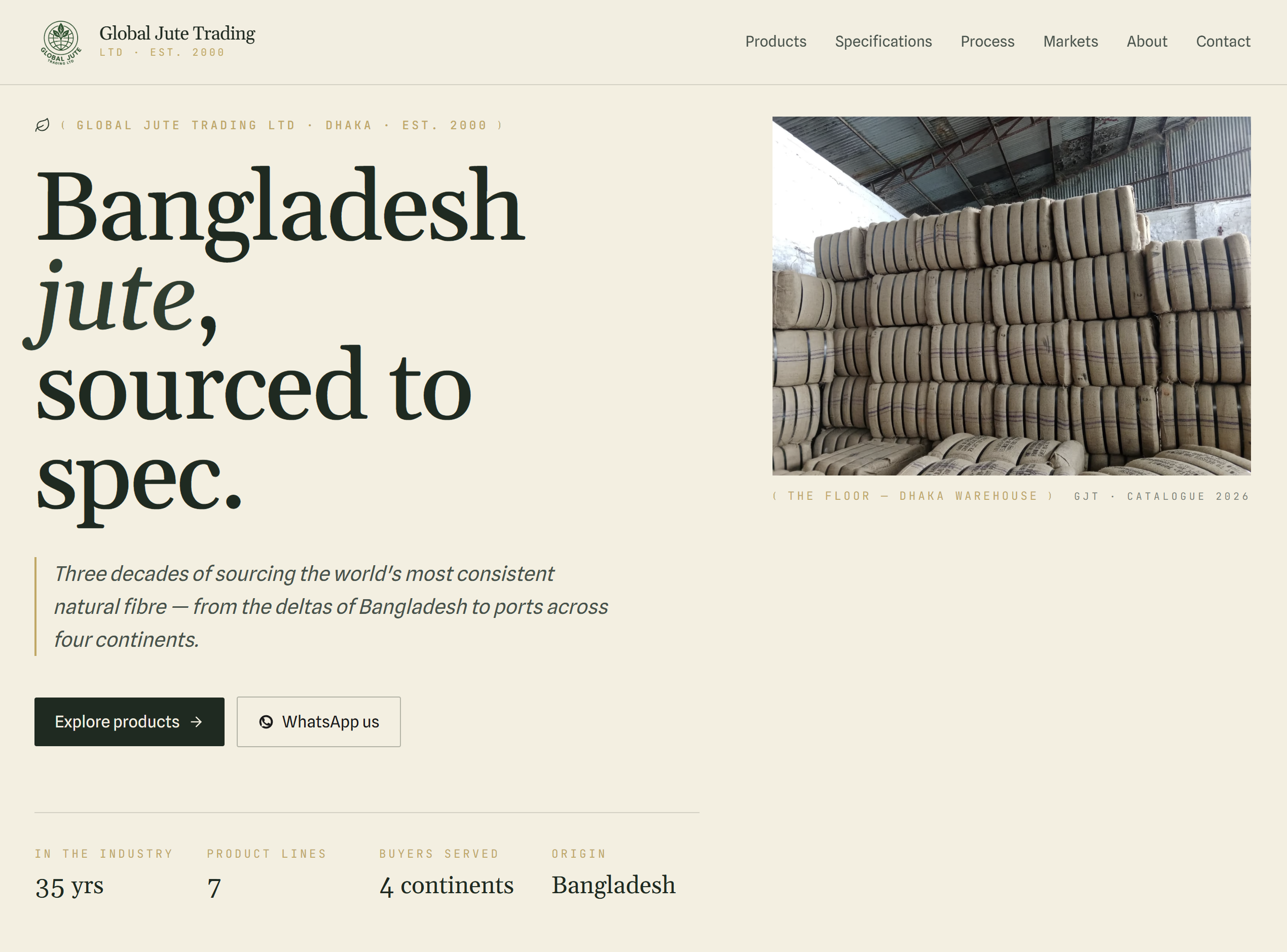
Homepage — "Bangladesh jute, sourced to spec." Editorial hero with the Dhaka warehouse floor and the 35 yrs / 7 lines / 4 continents stat band.
If we worked together.
I bring high-leverage product engineering and absolute operational discipline: shipping weekly, pressure-testing user inputs, and automating delivery pipelines.
See it in the wild.
This case study covers how Global Jute Trading was built — these links open what ships today: the live product, repo, demos, and supporting material.
TagRamp
A new LinkedIn for orgs that actually deal. TagRamp connects organizations from goals to meaningful business deals through AI-mediated intros. Built solo during the World's Largest Hackathon (May 2025) by Bolt.new and submitted to Y Combinator; now scaling with active enterprise pilots and CXO-level partnership discussions.