
Axis
Axis is the ELO product that never shipped, and the one whose idea I still think is right. It is field-workforce tracking — packages, jobs, deadlines, live location, minute-by-minute trails — but built on a multi-tenant premise that most such tools refuse: every logged individual is their own entity, and they can be engaged by several organisations at once. Cloudsight's SSO defines what each org can see, and vehicles and people are shared across companies by time window. Imagine a truck driver or a delivery rider working for three businesses in the hours that suit them, with each business seeing only its own scope. The worker earns more; the businesses stop paying for idle capacity.
The idea
Field-workforce software almost always assumes one employer per worker. Reality in a city like Dhaka does not: a driver with a vehicle has hours to sell, and several businesses each have peaks they cannot justify staffing full-time.
Axis modelled the worker as the primary entity and the organisation as a scope over them. That inversion is what makes shared capacity possible — the same driver can appear in three companies' operations, each seeing only its own tasks, its own trails, and its own hours, without three separate accounts or three separate apps.
What it does
- Org-scoped teams and hierarchy. Multiple teams with employee–manager structure, so tracking permissions follow the org chart rather than a flat admin flag.
- Live map view. A whole team or a single member at a glance, for dispatch decisions made in seconds.
- Trail history. Minute-by-minute movement replay for any selected day — the record that settles disputes about what happened.
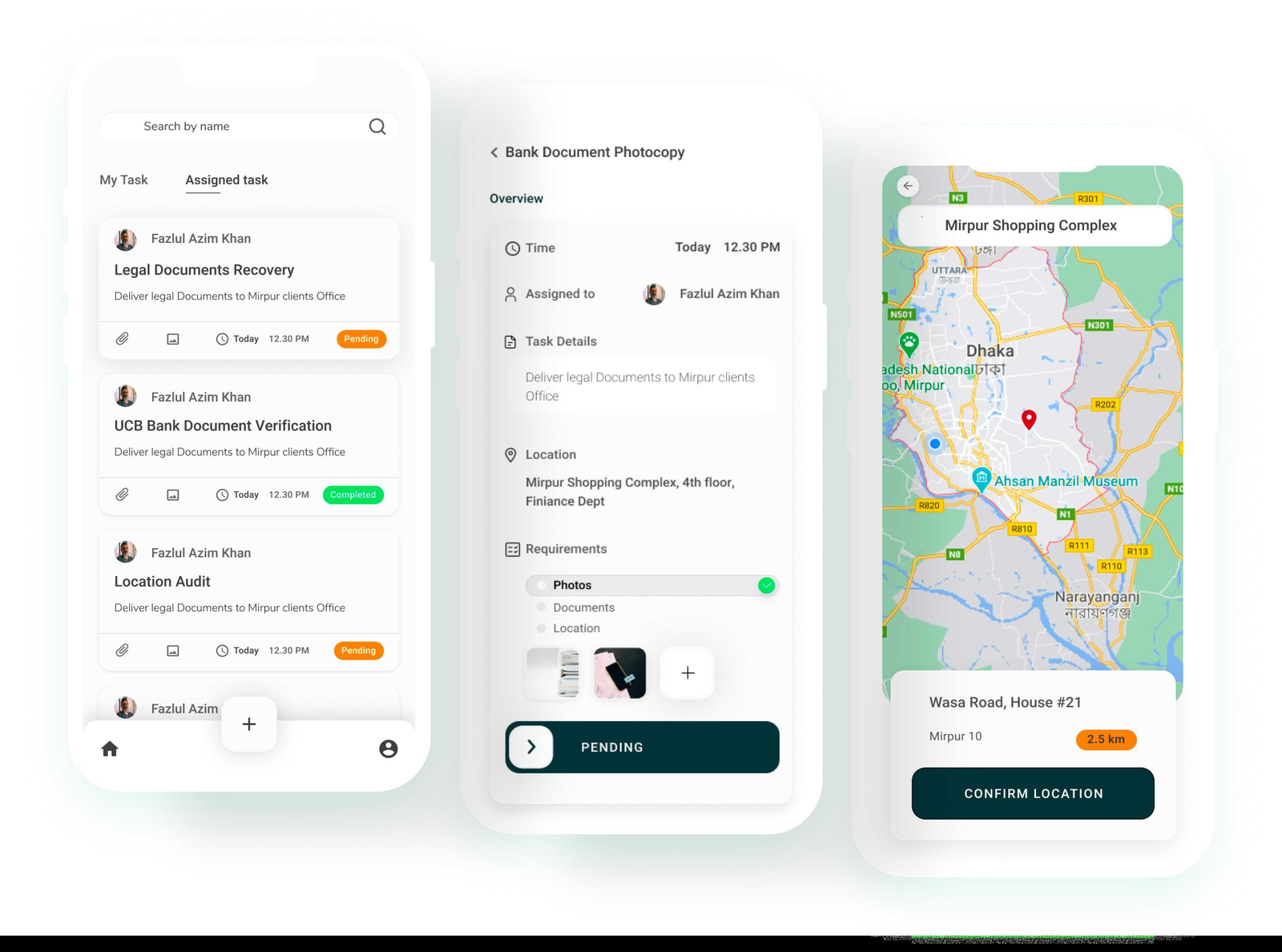
- Task workflows with proof. Deadlines plus per-task requirements: location confirmation, photos, documents. A job is complete when the evidence exists.
- Cloudsight SSO as the boundary. One identity for the worker, scoped access per organisation — the mechanism the whole shared-capacity model depends on.
Why it stayed internal
Axis was built as an ELO product for integration with Elobooks rather than for a single client, and it never went to market. The honest reason is the same one behind Anygum: the platform worked, distribution did not follow.
It is on this site because the design is the interesting part. The permission model — worker-first, org-as-scope, resource shared by time window — is the piece I would build again, and it is a straight ancestor of how modern platforms think about federated access.
By the numbers.
Axis — field task flow
The worker-side experience: assigned tasks with deadlines, a task detail with the evidence requirements that close it, and location confirmation on arrival.
Axis — assigned tasks, task detail with photo/document/location requirements, and on-site location confirmation.
If we worked together.
I bring high-leverage product engineering and absolute operational discipline: shipping weekly, pressure-testing user inputs, and automating delivery pipelines.
EKAGRA Health
Strategic health-tech partnership and equity investment in Bangladesh's most advanced clinical practice for wound care, diabetes, and nephrology. Spearheaded high-utility, HIPAA-compliant EHR clinical dashboards and scaled digital patient advocacy.